DIY/DIT Synthetic-Biology 3DP? Maker Citizen-BioScientists Build Community Labs For Bio-Hacking

Credentialism be damned! Unabashed amateurs, boundary jumpers and innovators without invitation are brushing aside (or simply ignoring!) the gatekeepers of the biology establishment—and building their own Life-Sci hacking labs. Hey, if the Digi-Tinkerers, iHobbyists and Electro-Makers can command their own hardware-centric places/spaces—and plan to disrupt the planet’s manufactories—then the DIY/DIT (Do-It-Together) “wetware” crowd are self-licensing to be just as ambitious.
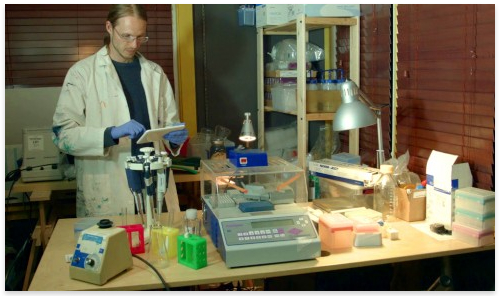
Biohacker Marc Juul works on a DIY bio experiment to create vegan cheese by engineering yeast to produce milk proteins. No bovines required! Photo courtesy of Real Vegan Cheese.

Biohacker Marc Juul works on a DIY bio experiment to create vegan cheese by engineering yeast to produce milk proteins. No bovines required! Photo courtesy of Real Vegan Cheese.

Would-be grassroots synthetic-biologists are now empowered by the same Three Disruptors—(1) Personal Computer, (2) Internet and (3) Social Media—as hardware makers. Moore’s Law multipliers—times these three disruptors—are also enabling the democratization of biology (and, I think, ultimately healthcare) via the DIY BioLab.

Bio-Hackers—going forward—are likely to make more intense use of 3DP-driven BioPrinters than digi-hardware maker/users do with traditional-material 3D printers. (According to Maker Media Inc. executives in July, one-third of their worldwide Maker Faire franchise—135+ branded events in 2014—is now driven by 3D printing. And, that percentage will only grow larger year over year.)

As I’ve opined before in this space, 3DP is the Fourth Disruptor. And, the only one of the four disruptors that transforms digits into atoms: Thoughts Into Things.

In the 3 October 14 SciFri (Science Friday) Public Radio International (PRI) program, Ira Flatow—award-winning host—moderated a show-discussion entitled “Community Labs Practice DIY Biology.” (For me, SciFri podcasts via iPhone end up helping to empower my time-shifted life.) Human biology is the substrate for human healthcare. And—as so many would-be patients now consult with “Dr. Google” first—a lot of us are already susceptible to a grassroots-level beginning to the new kind of healthcare experience for which we all crave. DIY Biology sounded like another way to take charge of one of life’s most intimate problems: personal health in an impersonal world— perhaps supported by cellular-level understanding of some of biology’s basics.

(You know I try to follow anything that smacks of present or prospective 3DP usage—especially in the healthcare field or its associated disciplines. And, I’m a devotee of DIY/DIT engines. Still, I was surprised by this “sudden” DIY BioLab exfoliation. Ira is not generally in the breaking-news business. So, I wonder what’s been going on—under my radar—in the Citizen BioScientist world? AND, how I’d managed to miss it!)
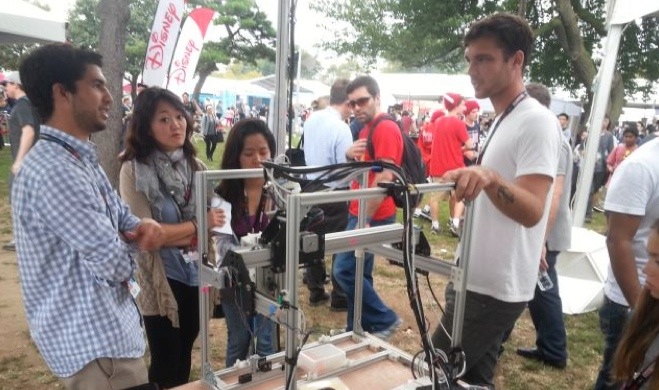
The OpenTrons open-source, liquid-handling robot built by Will Canine (a Genspace member). The robot---which won an Editor's Choice award from "Make:" Magazine at the World Maker Faire in Queens at the end of September---will be the focus of a Kickstarter campaign in November.

The OpenTrons open-source, liquid-handling robot built by Will Canine (a Genspace member). The robot—which won an Editor’s Choice award from “Make:” Magazine at the World Maker Faire in Queens at the end of September—will be the focus of a Kickstarter campaign in November.

Here’s how SciFri’s Flatow prefaced the segment on his Web-site’s textual iteration: “At community labs like Brooklyn’s Genspace, the Bay Area’s BioCurious [in Sunnyvale], and Baltimore’s BUGSS, members play around with PCR machines [polymerase chain reaction to amplify segments of DNA via thermal cycling] and bioprinters, extract their own DNA, and make bacteria glow in the dark.” The BioLab monikers alone promise high excitement and techie/hipster verve.

As it turns out, Brooklyn’s own Genspace (“New York City’s Community Biolab”) was the first—in 2009—of the DIY BioLabs to get off the ground nationwide. (Talk about under my very nose…)

To present a flavor for such a pioneering organization’s community-oriented sensibilities, here’s Genspace’s ambitious Mission Statement:

Genspace is a nonprofit organization dedicated to promoting citizen science and access to biotechnology. Since 2009 we have served the greater New York area by providing educational outreach, cultural events, and a platform for science innovation at the grassroots level.

In December 2010 we opened the first-ever community biotechnology laboratory, a Biosafety Level One facility in Brooklyn, New York, where we offer hands-on courses to the public, provide extracurricular experiences for students, and encourage scientific entrepreneurship, particularly in the fields of molecular and synthetic biology. As a community-based lab, we offer members the unique opportunity to work on their own projects and experience the joy and wonder of science firsthand.

As long ago as 2008—even before any lab actually opened its doors—the DIY BioLab community began to coalesce and organize. One of the first aggregating and education tools of the movement that year was DIYbio.org. For more on this clearinghouse, here’s their own online profile and associated links:

+++

An Institution for the Do-It-Yourself Biologist

DIYbio.org was founded in 2008 with the mission of establishing a vibrant, productive and safe community of DIY biologists.  Central to our mission is the belief that biotechnology and greater public understanding about it has the potential to benefit everyone.

+++

On 2 October, Ira showcased his two guests to help illuminate the grassroots BioLabs Movement. (Hey, if the Maker people can have a “Maker Movement”… BUT what the BioLabs Movement needs is an organization like Maker Media Inc. That is an enabler that can act as the community’s aggregator, media house, think tank, resource store, sales channel and event producer.) These two BioLabs insiders were:

Patrik D’haeseleer
Computational Scientist,
Lawrence Livermore National Laboratory;
Leader, Bioprinter Project at BioCurious (Sunnyvale, CA);
Co-Founder of new Counter Culture Labs, Oakland, CA. 

Todd Kuiken
Senior Program Associate, Science and Technology Innovation Program
Woodrow Wilson Centre
Washington, D.C. 

According to Flatow guest Todd Kuiken this DIY/DIT BioLab phenom has already led to the establishment of eight to ten such grassroots laboratories—mostly in big cities on the coasts.

3D BioPrinted Drug Development: Accelerated toxicity testing via “printed” human liver tissue: 
Organovo NovoGen Bioprinter

3D BioPrinted Drug Development: Accelerated toxicity testing via “printed” human liver tissue: 
Organovo NovoGen Bioprinter

People who come to play in nascent BioLab spaces often have no background at all in biology. Still, they are typically professionals in there own fields—often with a personal science-sector history and mindset. This may even include business chops to advance possible DIY BioLab proceeds to commercial and/or common-good status.

Serious Bio-Hacker interests demonstrated at BioLabs can stretch from fermentation for food entrepreneurship (real vegan cheese) to “ghost” organs (populating organ bio-structures with patient-specific stem cells) to life-disease research (toxicity of new drugs).

Would-be Bio-Hackers often find second-hand equipment on Craig’s List for cheap. Other sources of biotech-gear include corporate donations of superseded—but still viable—tech equipment. And, as usual, hackers and makers of all persuasions are expert at repurposing components and systems for “off label” uses. Think—in one SciFri guest example—CD Drive read/write head engines subbing for high-precision stepper motor systems. (Like the ones in the sophisticated Organovo bio printer depicted above.)

In our technology-infused society, Bio-Hackers continue to find that DIY-fostering components, equipment and techniques are accessible and cost-effective.

From my POV, bio printing brings the most excitement to the Life Sci party in the BioLab banquet space. Some 3DP-industry research houses project that in five years HALF of all 3DP business—by dollar volume—will be in the sophisticated use of 3D printing for healthcare.
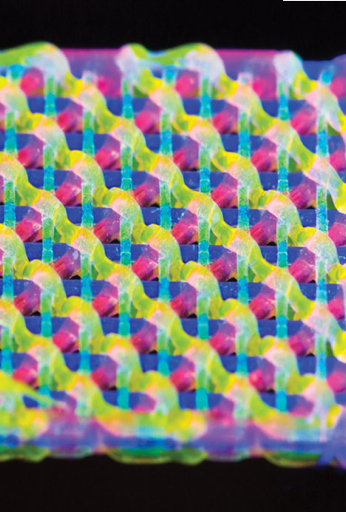
3D BioPrinted Tissue Via Cellular Inks: Multiple printing “Inks” create human tissue lattice-works with mechanical, electical & organic properties. Jennifer Lewis, Harvard, Prof of "
Biologically Inspired Engineering."

3D BioPrinted Tissue Via Cellular Inks: Multiple printing “Inks” create human tissue lattice-works with
mechanical, electical & organic properties. Jennifer Lewis, Harvard, Prof of “
Biologically Inspired Engineering.”

Bio printing is the use of living cells to 3D-print bio-active tissues. The ultimate healthcare goal is fully functional—and patient-DNA-specific—human organs that can be transplanted successfully longterm without the immense problems of tissue rejection.

SciFri guest Patrik D’haeseleer commented that Bio-Hackers usually stay away—at least for now—from bio printing in their DIY environments for two reasons.

First is the high-maintenance requirements of human cells. They are simply very fragile and would demand constant attention. The second is that bio printing is one of the most commercially contested areas of 3DP at the moment. It’s not an area in which DIYers would seem to be able to contribute much—because of the inherent cost of matching rapidly advancing technology. (I might posit that this latter issue is precisely the reason why the inherent inventive and innovative nature of Bio-Hacking COULD probably add value to the practice of bio printing!)

Exchanging with his guests, Moderator Ira directly addressed one of the public’s major perceived concerns about Bio-Hacking. This is especially prevalent at the sophistication level of rapidly developing bio printing. Are we likely to see a new Dr. Frankenstein 3D- print organs for his additive-manufactured monster? “He’s alive!…but his cerebral-cortex build has slumped…!”

SciFri Flatow remarked, “Usually—when Do-It-Yourself Bio is covered, Todd, in the media—the concern is ‘amateur scientists breeding super-viruses.’” Todd Kuiken presented one antidote to journo sensationalism. He discussed a professional survey done to debunk the more flamboyant headlines that are presented in the “if it breeds, it leads” mode of newspaper salesmanship.

Most of the techniques and experiments Bio-Hackers are doing are relatively safe. Furthermore, the Wilson Center and  DIYbio.org started the “Ask Program.” This is a BioLab partnership with members of the American Biological Safety Association. The goal is to give DIY experimenters access to bio safety pros—to enable the relay of questions and answers about experiments. “The [DIY bio] community is being extremely proactive in terms of issues around bio safety and security to assure the work [Bio-Hackers are doing] is safe,” said Todd.

As Ira remarked, the ebola epidemic is on everyone’s minds… This is perhaps the perfect example of contagion unleashed by system failures—compounded by a lack of understanding and appropriate action among stricken populations.

Ira Flatow, SciFri and guest leaders in the world of DIY BioLabs were convincing in their answers to safety questions. All while they were compelling in their presentations of the grassroots virtues growing at the BioLab community level. Citizen BioScientists are out to breed solutions to biology ignorance and irrational fears—for the betterment of our citizenry and our society.

C’mon Back!

LAND


facebooktwittergoogle_plusredditpinterestlinkedinmail
Posted in Email, HOME, NY3DPWeek, Views | 1 Comment

The Future of Making Products: How Software-Maker Autodesk Intends To Disrupt Manufacturing With Intelligence…AND 3DP

Autodesk—one of the old-line tech companies with the greatest commercial opportunities in new-line 3DP—enjoys leadership that can talk. Better: take the stage and educate, authenticate, prognosticate…AND inspire.

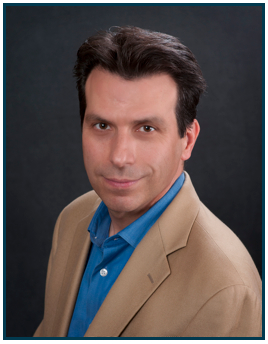
Andrew Anagnost, Autodesk Senior VP, Industry Strategy & Marketing, does corporate strategy as stand-up comedy at MakerCon New York 2014 on 18 September 2014.

Andrew Anagnost, Autodesk Senior VP, Industry Strategy & Marketing, does corporate strategy as stand-up comedy at MakerCon New York 2014 on 18 September 2014.

With this last, inspiration moves and compels—powered by the corporate vision Autodesk foresees. This is all while promising to lead individuals and industries to a new commercial and common-good reality. And—not surprisingly—a reality ADSK (the stock symbol Autodesk often uses for internal short-hand) will help them to fulfill.

I’ve marveled at the room-mesmerizing presentation craft of Autodesk’s Carl Bass—President & CEO—at other 3DP sector events. You can’t help but love Carl’s—you immediately want to be on a first name basis with this guy—aw-shucks / off the (rolled-up) cuff / wander-the-stage delivery of disruptive ideas. Carl’s opined concepts are the kind guaranteed to make short-sighted Wall Street analysts quail in fear of ADSK equity value.

Now, MakerCon Day 2 showcased yet another Autodesk senior spokesperson with stage chops and provocative revelations: Andrew Anagnost, Autodesk Senior VP, Industry Strategy & Marketing.

MakerCon was Maker Media, Inc.’s debut of its first “Maker Movement Conference” in New York City—more or less for “professional makers”—on 17 and 18 September. This was just before Maker Media’s “Flagship” World Maker Faire New York 2014. MakerCon consolidated a number of prior events around World Maker Faire—including the Hardware Innovation Workshop, a clinic on making Maker Spaces and Education Day.

So, on Day Two—compliments of Autodesk strategic positioning and clearly of a piece with a new corporate-storyline of serious intent—we laughed with light-footed Andrew Anagnost. His comedic schtick served to spotlight a profound juxtaposition. Andy (another at-ease first name!) casually walked about and talked about killing his company’s “children”—his established corporate products—before emerging assassins murdered them in the heartless marketplace.

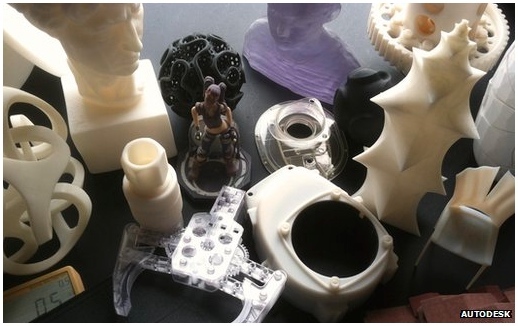
A potpourri of 3D printed objects created using Autodesk software.

A potpourri of 3D-printed objects created using Autodesk software.

I’m circling back to comment in detail on THIS particular MakerCon presentation for key reasons.

I believe Andy Anagnost’s speech points the directions of major drivers of 3DP—including new engines of the company’s business model, its ubiquitous software and Autodesk (itself!). Thus, I’m convinced this Autodesk exec’s talk is of high importance for those who would understand where we’re going in 3DP—and who is leading us there.

SVP Andy framed his comments with the impact of digital tech, infinite computing power (“a supercomputer for everyone”) ubiquitous sensors, mechatronics—and the subsequent rise of human-complementing(??) robots.

As result, the workforce is becoming “nomadic” and/or working virtual. So, Autodesk is now convinced it needs to create software tools that can perform exceptionally in this disruptive new environment, too.

Tracking the advent of “smart everything,” ADSK is now addressing the intellectual elements of manufacturing. If our making systems are becoming more and more clever, we have to be cleverer still—in turn—about how we manage such powerful production assets. From both a commercial AND—implicitly—a common-good perspective.

The Local Motors “Strati” 3D-Printed, open-source, crowd-designed-winner car parked in front of MakerCon New York, NYSCI—”built” in 40 hours of realtime printing on a public exhibit-stand at the Intl Manufacturing Tech Show 2014 (in Chicago Sept 8 to 13, McCormick Place). Photo compliments J. E. Earle/Eventifier.

The Local Motors “Strati” 3D-Printed, open-source, crowd-designed-winner car parked in front of MakerCon New York, NYSCI—”built” in 40 hours of realtime printing on a public exhibit-stand at the Intl Manufacturing Tech Show 2014 (in Chicago Sept 8 to 13, McCormick Place). Photo compliments J. E. Earle/Eventifier.

Andy talked of “Fabless Manufacturing” of the (very near!) future where we will consolidate our making in shared facilities. He pointed to Local Motors—an Autodesk Spark-platform strategic partner—with that disruptive car-making startup’s dispersed production and “delivery” plan.

Underscoring this point—vividly and palpably—was Local Motor’s first-ever, open-sourced (and fully operational) 3D-printed runabout—the Strati—sitting at the front curb outside NYSCI’s central-building complex at the WMFaire-grounds in Flushing Meadows, Queens.

SVP Anagnost predicts high-performing societies around the world will begin to engage in a “Consumption Shift”—driven from the bottom up. This will start in the Golden Grassroots with high-margin buyers. These Discerners will insist on knowing—and thereby educating and modulating their intake—about the provenance, pluperfect performance specs and the post-usage arc of the products they buy and services they consume. How, where, when and by whom was it made/served? How long will it last? Is it toxic on any level? Is it sustainably disposable?

[These neo-manufacturing eventualities may begin to temper neo-classic capitalism---and its detrimental excesses---on a DIT (Do-It-Together) Regulation basis. If (corporately bought-and-sold) government’s continue to fail their responsibilities, empowered and interconnected citizens---with informed pocketbooks---may end up governing the producers on their own. With individual and collective acts of commercial soft-protest… –- LG]

Rear deck of the Local Motors "Strati" 3D-printed, open-source operational car parked outside MakerCon NY '14 at the NYSCI complex in Flushing Meadows, Queens; standing in the background is Jay Rogers, Local Motors' CEO & Co-Founder.

Rear deck of the Local Motors “Strati” 3D-printed, open-source operational car parked outside MakerCon NY ’14 at the NYSCI complex in Flushing Meadows, Queens; standing in the background is Jay Rogers, Local Motors’ CEO & Co-Founder.

These high-end expectations will diffuse through the other strata of every developed society. In consequence, these changing buying/consumption patterns will drive a fragmentation of demand. Challenging client/customers are going to insist on bespoke solutions—and 3DP will enable playing to such exigent stipulations. These new and different expectations will call for unprecedented customization regimes.

Andy called this vision “mass-produced customization.”

Adding another entire level of intelligence “aboard” or (abroad!), every product will automatically join the Internet of Things (IoT)—unless sequestered for different reasons. Along with other “ho-hum” presumptions, customers will assume hyper-local and/or cloud linking of even mundane products: a soon-to-be unexceptional expectation of Net connection.

From ADSK’s POV, the Internet of Everything (IoE) will require a “blending of hardware and software.” This synergy—the Venn Diagram “sweetspot” of hardware, software and customer exigencies—is apparently Autodesk’s strategic-positioning goal. Andy states “Things are going to be very intelligent”: they will be “SmartThings.” [And, OBTW, I’m confident ADSK intends to own as much of that Venn smart-geography as possible---all for YOUR betterment, of course…! --- LG]

According to SVP Anagnost, another Autodesk strategic vision is the Evergreen Product.

Major consumer systems (think your automobile or your washer-dryer) in your life will be iPhone-ized. Many consumer electronic products are regularly upgraded with new software releases. Because your car or washing machine’s digital intelligence will be wirelessly integrated into the IoE—and entirely empowered by software combined with protean hardware—it will “evolve” overtime. The system will present you with new software upgrades—with novel functionalities and value-adds—as your vendor strives to keep you connected. That’s both to the IoE and to his/her company.

Your delight is the provider’s goal. (And, sometimes it will seem perfectly appropriate for your vendor to charge you for the Next Rev.)

Tesla Motors—one of the two most innovative auto makers on the planet (the other is Local Motors)—is already promising that “we’re going to make the [Tesla] car better [on a current customer-specific basis] over your time of ownership.” And—you guessed it—Autodesk is ALSO a strategic partner of Tesla…strange how that seems to be working…!

To move the company’s agenda ahead as rapidly as possible, Andy of ADSK is out to create a “3D literate consumer class”—and an integrated 3DP ecosystem for that group to play in.

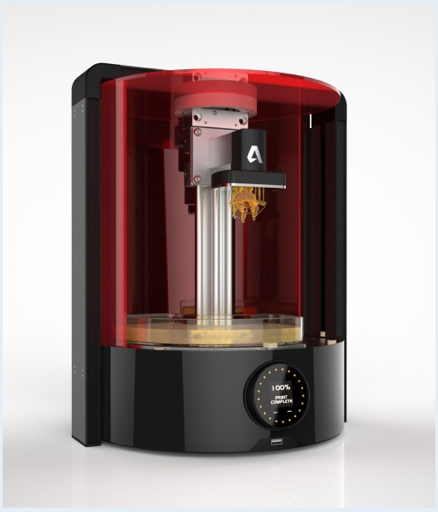
Autodesk's (yet to be named or released) STL, semi-pro, desktop 3D Printer: a will-be working and for-sale "proof of concept" to demo the new ADSK Spark software suite---as much as a market-targeted hardware launch.

Autodesk’s (yet to be named or released) STL, semi-pro, desktop 3D Printer: a will-be working and for-sale “proof of concept” to demo the new ADSK Spark software suite—as much as a market-targeted hardware launch.

Primary elements of this “literacy” strategy include free software products for schools and universities; new ancillary “tools” like Fusion 360, cloud-based CAD/CAM for collaborative development and 3DP output; the free “Spark,” open-source, 3D-printing software platform (as an operating system to drive many varieties of 3D printers); and the company’s own ADSK 3D printer.

These last two key elements are likely to be further profiled—and the no-name printer officially debuted(??)—at the “Inside 3D Printing Santa Clara” Conference and Expo on 21 to 23 October.

Andy opined that “Spark would be the PostScript of the [3DP] future.” (For those of you who missed the desktop-printing {DTP} revolution—that’s 2D laser-printing: think Apple’s prime-mover LaserWriter—of 30 years ago, PostScript was the “universal” laser-printer application that empowered that revolution across printer platforms.)

Buttressing these Autodesk senior-management vectors, Carl Bass was quoted in May as saying, “I think we’re really at the beginning of a new way of making stuff—and [at Autodesk] we’re just trying to kickstart it.”

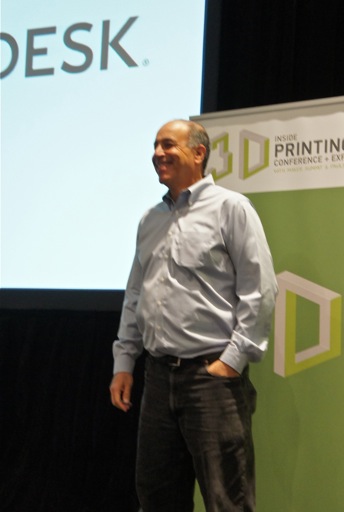
Carl Bass, President & CEO of Autodesk, presenting his Keynote at "Inside 3D Printing" at the Javits Center, NYC, on 4 April 2014.

Carl Bass, President & CEO of Autodesk, presenting his Keynote at “Inside 3D Printing” at the Javits Center, NYC, on 4 April 2014.

At MakerCon in New York, Andy Anagnost ended his presentation “provocations” by stating that executive/strategists at ADSK were out to “kill their [own Autodesk product] children with new ecosystems.” He concluded emphatically with: “we WILL be the SELF-disruptor!”

C’mon Back!

LAND

facebooktwittergoogle_plusredditpinterestlinkedinmail
Posted in Email, HOME, NY3DPWeek, Views | Leave a comment

MakerCon—New “Big Tent” Conference For Makers—Debuts In New York City With 3DP-Related Roll-Outs

Maker Media, Inc. (MM) continues to coalesce new communities from its “Maker Movement”—a booming phenomenon that it both helped to birth and continues to support. Now, MM is reworking its offerings again—in response to the opportunities afforded by the explosive growth of its Maker Faire “franchise.”

MakerCon New York 2014 debuted in the week prior to the 5th Annual World Maker Faire NY '14.

MakerCon New York 2014 debuted in the week prior to the 5th Annual World Maker Faire NY ’14.

Just a few months ago, Maker Media announced that it had reached the milestone of 100 Maker Faires-worldwide. Today, Dale Dougherty, CEO of Maker Media, personally announced MM will debut 35 new Faires of various sizes in THIS year. This includes another “flagship” event in London in 2015.

Why should those in 3DP commerce or common-good care about the Maker Movement? Because—as I discovered in my interviews of Maker Media execs in July—fully one third of Maker activity at World Maker Faire New York 2014 will be driven by 3DP in one form or another. And, the action at MakerCon NY 2014 buttresses the trend to even greater mutual and aligned growth in this natural integration of Makers and 3DP.

3DP is booming. The Maker Movement—as confirmed by Maker Faire ecosystem, global hyper-expansion—is booming. The two vectors are now synergistic.

Previously, MM had held a hardware innovation event for Maker “pros”—those building businesses in Maker disciplines—in the official “Weeks” before its two flagship Maker Faires in San Francisco and New York. In addition, Maker Media presented ancillary workshops on building, marketing and managing Makerspaces. In the “Weeks,” MM also held “education days” for teachers interested in Making as a platform for programs—from STEM-based curricula to afterschool to fostering young makers.

MakerCon Logo RocketNow, Maker Media has amalgamated all of these Maker events under a two-day, over-arching event that the company is calling “MakerCon”—short for Maker Movement Conference. MM rolled out the first MakerCon at Maker Faire Bay Area 2014 in May. The company is now presenting its second here in New York City at World Maker Faire Week on 17 and 18 September.

Dale Dougherty—as MakerCon ”Master of Ceremonies”—opened the new Maker get-together with these cogent remarks: ”MakerCon is now an umbrella event. In the past [in the week prior to our flagship Faires], we focused on hardware innovation—mostly for the ”pro” Makers. BUT something bigger was happening. That’s why we created MakerCon. [To celebrate the broader Maker Movement drive] to do things that come out of our own heads and share with others. MakerCon is also about civic and education impacts: on and for the community.

“Last wkend there were 10 Maker Faires in America: over 135 this year. We’re no longer just the business of Making and the tools, BUT the civic aspects. And, we have the ambition to [help] create the leaders of the Maker Movement. Something that is powerful and important.”

In prior comments, Dale had foreshadowed his MakerCon intro with these supporting ideas: “ The Maker Movement is providing new insights into local and global manufacturing, design, workforce development, education and creative culture. We are excited by the growth of makerspaces in communities, in a variety of settings from libraries and schools to city centers and in industry. National and local government leaders are trying to understand how to support the growth of the Maker Movement. Even large corporations are trying to figure out how the Maker Movement impacts their interactions with customers and the kinds of products they develop.”

In the following, Day-One morning sessions, MakerCon quickly proved that it was suddenly the place to be, be seen and be active in rolling out Maker/3DP ideas, relationships and products.

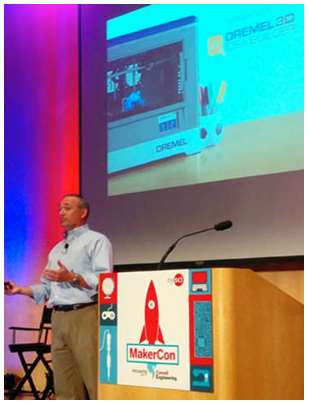
John Kavanagh, President of Dremel, rolled out the company's first foray into 3DP with its innovative Idea Builder desktop 3D Printer.

John Kavanagh, President of Dremel, rolled out the company’s first foray into 3DP with its innovative “Idea Builder” desktop 3D Printer.

The President of famous, old-line, 80-year-old Dremel Tools (which could be called the Makers’ “Pocket Machine Shop”) took the stage and introduced his company’s debut entry in the hyper-competitive world of desktop 3D printers. John Kavanagh presented the “Dremel 3D Idea Builder,” which “builds on the [Dremel] legacy of easy-to-use tools” with a “comprehensive 3D printing ecosystem empowering a new generation of makers to build revolutionary projects for creative and functional purposes.”

According to Dremel, the Idea Builder features easy-to-use functionality, full-featured tools and family and environmental friendliness—all at an aggressive $999 MSRP and availability at selected Home Depot stores in November. Looks like a homerun off the bat.

(See 3DPI’s in-depth and incisive Dremel companion piece by Editor Rachel Park.)

And, the new MakerCon New York was Dremel’s debut venue—reinforcing the alignment of Making and 3DP.

C’mon Back!

LAND

facebooktwittergoogle_plusredditpinterestlinkedinmail
Posted in Email, HOME, NY3DPWeek, Views | Leave a comment