3DP & Human Health (Part 3): Printing Exo-Solutions For Non-Invasive “HuBod Printed” Healthcare Mashups That Deliver Innovative, Patient-Specific Prosthetics

Welcome To The Third Installment In Our Blog-Post Series On HuBod Printing. Here We’ll Continue From The Point-Of-View Of  3DP Democratization Of The Healthcare Industry, Including What I’m Calling “Maker Care”—An Offspring Of The Maker Movement…

A Pair of Robohands, A Seminal Example of DIY/DIT 3DP-Driven "Good-Enough Tech" (GET). Thanks to MakerBot for the photo (these Robohands were made on a MakerBot printer).

A Pair of “Robohands,” A Seminal Example of DIY/DIT 3DP-Driven “Good-Enough Tech” (GET). These Robohands were made on a desktop MakerBot printer by collaborating Makers on different continents and are working and effective prosthetic solutions for missing digits.

“HuBod Printing”—for Human Body—is my coinage for the spectrum of powerful mashups and integrations 3DP players are creating between Additive Manufacturing and Healthcare.

Some of our most creative 3DP players work at the grassroots and community level as the proudly un-credentialed. 3DP democratization of the Maker Movement has empowered entirely new Maker forays into evermore sophisticated fields of “inspired tinkering.”
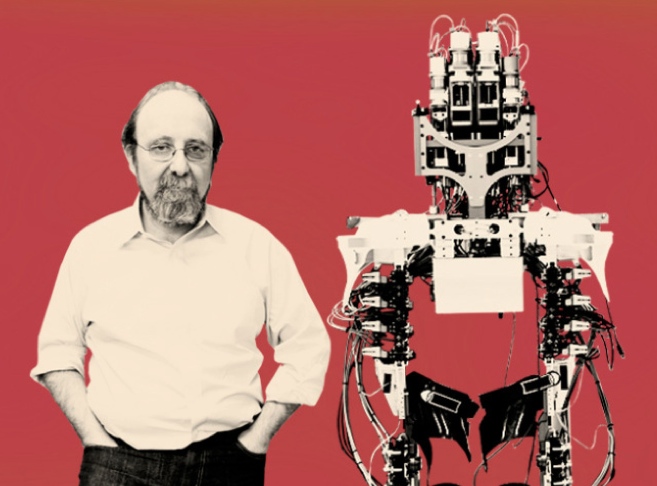
Neuroscientist Dr. Miguel Nicolelis & one of his mind-controlled, exoskeleton robots that enables the paralyzed to walk via thought commands.

Neuroscientist Dr. Miguel Nicolelis & one of his mind-controlled, exoskeleton robots (the “Walk Again”) that enables the paralyzed to ambulate via thought commands. The “Walk Again” will debut on 12 June at the World Cup in Brazil, when a paraplegic will literally make the first kick to open the Cup while wearing a Walk Again.

Among these novel initiatives are “BioFacturing” efforts that stem from non-invasive “exo-solutions”—think the insect exoskeleton with its body’s chitin armature as external infrastructure. 3DP/HC exo-solutions spectrum from simple—but DIY-innovative and product-creation paradigm-bending—prosthetics (“Robohand“) to body-mobility exoskeletons that empower paraplegics and quadriplegics (wearable robots and digi-mech body suits like the “Walk Again” and the “Ekso-Suit“).

In the new business of exo-solutions to healthcare problems, 3DP-driven BioFacturing presents a number of advantages. This includes organic ramping-up of tech evolutions, iterative processes to enable wide experimentation, inexpensive use of resources, effective response to changing parameters (e.g., a child’s growth) and hyper-customized, patient-specific designs.
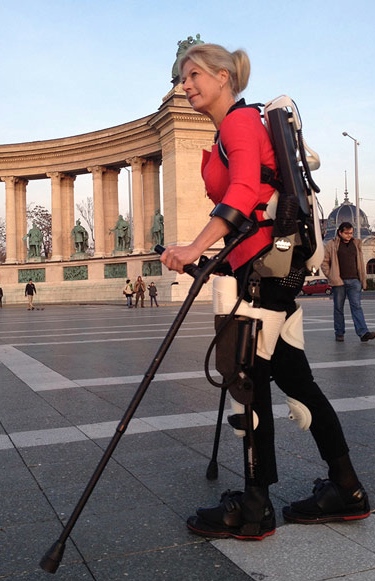
Paralyzed former-skier Amanda Boxtel & 3D System's "Ekso-Suit"---described by the company as the "first ever 3D printed hybrid Exoskeleton robotic suit"---demos her hyper-customized wearable robot on debut in February 2014.

Paralyzed former-skier Amanda Boxtel & 3D System’s “Ekso-Suit”—described by the company as the “first ever 3D printed hybrid Exoskeleton robotic suit”—demos her hyper-customized wearable robot on its debut in February 2014.

In this series of posts on 3DP and Human Health, the exo-solutions we are now examining have another crucial attribute. They are all non-invasive. And, thus empower wide investigation with and by real people without the constraints of our U.S. healthcare system’s “walled garden” of credentialism and gate-keepers.

Robohands is the now-classic (debuted in Spring 2013) example of Good-Enough Tech (GET) in highly successful use in 3DP-driven, human-health solutions.

Two Makers—one (Ivan Owen) in Washington State and the other (Richard Van As) in Johannesburg, South Africa—learned about each other via the Internet and teamed up to collaborate on a GET project. Richard had lost fingers in a carpentry accident and Ivan had experience with mechanical prop hands. Both were Makers.

Then, MakerBot—the desktop 3DP printer manufacturers here in Brooklyn—donated two Replicator 2s: one for each Maker. This new capability slashed the iteration times to minutes from weeks. The power of the Internet eliminated the traditional latency of the 10,000 miles between them.

So enabled, the two collaborators were able to supercharge their efforts and accelerate their deliver of a viable solution to Richard. The rest—as the cliche goes—is history…but a very important “history” AND future. From first success, Robohand has become a low-cost, worldwide, patient-specific and GET solution for—in particular—children with lost fingers or who were born without fingers.

We’ll be continuing the discussion on 3DP’d exo-solutions here—as part of our 3DP and Human Health blog-post series, so…

C’mon Back!

LAND


facebooktwittergoogle_plusredditpinterestlinkedinmail
Posted in Email, HOME, NY3DPWeek, Views | 3 Comments

3DP & Human Health (Part 2): Innovative Additive-Manufactured Healthcare Infrastructure–Via “HuBod Printing”–Will Underpin Our Coming Health Advances

“HuBod Printing”—For Human Body—Is My Coinage For The Spectrum Of Powerful Mashups & Integrations 3DP Players Are Creating Between Additive Manufacturing And Healthcare. Welcome To The Second Installment In Our Blog-Post Series On HuBod Printing…

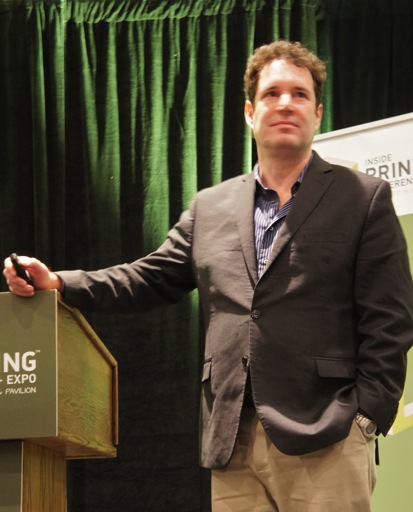
Hod Lipson, Associate Professor, Cornell University, co-author of FABRICATED and the overall Master of Ceremonies at "Inside 3D Printing" at the Javits Center, NYC, on 3 April 2014.

Hod Lipson, Associate Professor, Cornell University, co-author of FABRICATED and the overall Conference Chairman at “Inside 3D Printing” at the Javits Center, NYC, on 3 April 2014.

According to Hod Lipson—holding forth as Conference Chairman of “Inside 3D Printing NY ’14″ at NYC’s Javits in early April 2014—3DP-driven healthcare is now the fastest growing segment of all the booming sectors in today’s Additive Manufacturing revolution.

And—as I said in our first post in this series [19 May]—HuBod Printing “may have the greatest impact on human well-being AND the cost of delivering that well-being…” 3D Printing will have a totally unexpected upside vis a vis healthcare—AND that impact will extend to the radical reduction in healthcare expenditures at every level.

Here’s our current-series’ Outline Headings. (Of course, these 3DP/HC topics are subject to on-going evolution as fast-paced HuBod Printing continues to accelerate its penetration of the Human Health marketplace:)

  • DIY-Prosthetics Maker Care
  • Orthopedic Appliances
  • Dentistry, Labless & Less Costly
  • Hearing, In-Ear Systems
  • Patient-Specific Implants
  • Biomedical Scaffolding
  • Bioprinting
  • Ethics & Regulation
  • Human Body CAD
  • 3D-Printed Drugs
  • Nutrition Printers
  • HC, MedSci, BioEng Education
  • Public Health Issues
  • Impacts: Commercial, Social, Legal, Public Policy.

+++

3DP has begun to democratize invention and innovation.

America has traditionally been the nation of tinkers turned entrepreneurs (who sometimes graduate to become titans of industry). Think Robert Fulton, Eli Whitney, Samuel F. B. Morse, Thomas Edison, The Wright Brothers, Henry Ford… Our list of amateur inventors—later proclaimed as geniuses based on results—is very long.

Now, Additive Manufacturing/3D Printing is empowering a much wider swath of “makers”—by definition often from the great unwashed and certainly the uncredentialed—to “tink.” These Digits & Atoms Tinkers are creating solutions in every field of “manufacturing” endeavor—including 3DP’d “BioFacturing.”

3DP—allied with the Internet—presents a completely new paradigm of the possible. Additive Manufacturing/3DP Printing empowers the creative and effective manipulation of atoms. The Internet—pure digits—delivers access to knowledge, resources, connections and markets.

This 3DP/Internet “partnership” is democratizing the advance and betterment of  healthcare, too.

Healthcare in the U.S.—and other countries of the industrialized world—is set apart. Protected, in a word. It is highly regulated by governments, credential-ized by higher-education institutions and affiliation groups and constrained by “gate-keepers” political, social and commercial. Still, 3DP is now helping to disrupt the constricting infrastructure that has traditionally kept healthcare a preserve of a select few—be they professional, organizational or social players.

3DP/Internet democratization has kicked off a kind of “personal manufacturing” (see Chris Anderson’s book “MAKERS, The New Industrial Revolution“). 3DP/Internet “engines”—reviving and supercharging the old American tradition of tinkering in garage or basement—are now delivering up the American “Maker Movement.” The Maker—and Maker Space—is the locus of DIY and DIT (Do-It-Together).

The Maker Movement has its own primary driver in Maker Media, Inc. This “media” company covers much more commercial ground than the traditional organization of its kind.

Once upon a time (the 90s)—as a tech-marketing maven/consultant—I used to lecture about the business-success uses of the “Trade Tripod.” I defined the Tripod’s three “legs” as (1) Trade Publication, (2) Trade Show and (3) Trade Association. Besides the three-way focus on a single industry (“Trade”), the Tripod was all about The (Multiple-Purpose) List—or the Community (with well-profiled members) that the Tripod served.

Few single, stand-alone organizations managed to incorporate all three legs of the Tripod under one roof. Two legs were generally good enough for cross-fertilizing success (most often—in tech—a Trade Publication and a Trade Show).

Now, the Internet has both empowered—and diminished—the Tripod concept, structure and uses. For instance, the Internet—with its ubiquitous-connection and communication capability—threatens the traditional functions of the Trade Association.

Maker Media, Inc.—eschewing Association structure and function—actually acts like an informal affiliation group. In addition, Maker Media markets and sells products via its Maker Shed. This online and “pop-up” (at Maker Faires) retail organization delivers many of the products that help enable its Maker community. So, you might say Maker Media added a fourth “leg” to the Tripod: that of a retail resource for essential products and components (including educational kits and how-tos) for its industry segment. This Maker Media service is as much about empowerment as it is profit.

[I'm going to end this post here. BUT, the topic---3DP democratization of industry sectors, including healthcare---needs additional scrutiny, insights and educated specualations. So, next: Maker Care and a compelling example of how it has worked in the real world of DIY and DIT within the Maker Movement...]

C’mon Back!

LAND


facebooktwittergoogle_plusredditpinterestlinkedinmail
Posted in Email, HOME, NY3DPWeek, Tools | Leave a comment

3DP & Human Health: 3D Printing Is Rapidly Evolving Organic Solutions For New Healthcare Regimens: Goodbye “Bionic Man,” Hello “HuBod Printing!”

Additive-Manufactured Healthcare Is The Fastest Growing Segment Of The Booming 3D Printing Sector & In This Post We’re Outlining A Current Overview Of This Segment As The Start Of A Series On What We’re Calling “HuBod [Human Body!] Printing”…

The Economist--"Printing a bit of me" article illustration of 8 March 2014 (thanks to the publication and its Matt Herring).

The Economist Magazine–”Printing a bit of me” article illustration of 8 March 2014 (thanks to the publication, and its Matt Herring, for this conceptualization and use).

Personally, I think Additive-Manufactured Healthcare promises to be THE most exciting—and important—development in the 3DP Revolution. 3DP is beginning to disrupt many key industrial, professional and commercial sectors in our society and around the world. BUT, 3DP/Healthcare may have the greatest impact on human well-being AND the cost of delivering that well-being…

To explore this importance and impact, we’re launching a blog-post series here at NYC3DP.com that will focus on “HuBod Printing” over the next weeks and months.

Continue reading

facebooktwittergoogle_plusredditpinterestlinkedinmail
Posted in Email, HOME, NY3DPWeek, Views | 1 Comment