NYC Healthcare Leaders Affiliation Group Intros 3DP’s Latest Human-Health Impacts To Its Diverse Executive Constituency Via Debut “3DP & Healthcare” Panel

Incredibly Innovative Healthcare Solutions—At Every Level—Are The Fastest Growing Segment In Our 3DP Revolution: The Broad  Spectrum Of Human-Health Players In New York City Are Now Organizing To Align And Advance With Accelerating 3DP Change…
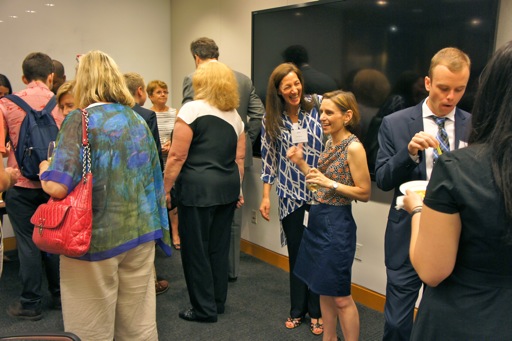
 

Bunny Ellerin (3rd from right, in dark blue skirt), President & Co-Founder of NYCHBL, greets constituents and guests at the reception before NYCHBL’s panel “The 3D Printing Revolution Meets Healthcare” at Cooley LLP, New York City, 17 June 14.

Bunny Ellerin (3rd from right, in dark blue skirt), President & Co-Founder of NYCHBL, greets constituents and guests at the reception before NYCHBL’s panel “The 3D Printing Revolution Meets Healthcare” at Cooley LLP, New York City, 17 June 14.

Healthcare is one of America’s most conservative businesses. Yes, practicing at the doctor level can present life-or-death circumstances…literally. So, it’s hard to fault healthcare (HC) practitioners for their inherent prudence in the interests of patients.

Sadly, the conservative mentality that protects patients also tends to penalize HC-industry players—of all stripes—in advancing their broader commercial and common-good interests. (And, yes, the once “august profession” of doctor-driven medicine is now a profit-making enterprise—like any other—regardless of the individual practitioner’s moral, ethical and “unbusiness-like” approach to human healthcare.)

In the U.S., the furtherance of HC business is coupled with the furtherance of HC science. In America’s hyper-capitalist society, it’s hard not to co-align the two. Still, the HC industry today is seeking the most effective balance of (often conflicting) interests. In fact—for the rapid betterment of American healthcare delivery (better results at a lower cost)—it may be essential to assure that we integrate HC business and science as closely as possible.

The sought-after result is an improved “art” of HC for more Americans. (Measured against all industrialized countries, the cost of U.S. HC is far-and-away the highest—while delivering results that are mediocre…or worse.) For our larger society’s benefit, HC—the enterprise—now has a great opportunity to deliver the greater art of human health.

Our HC industry can achieve new levels of HC art by harnessing, integrating, disseminating and managing the accelerating advances—and seemingly constant breakthroughs—in medical technology today.

Many of the most startling—and far-reaching—innovations in healthcare are emerging from the 3D printing (3DP) segment.

HOWEVER—to do so—we circle back to the problem of inherent conservatism in the HC industry. Prudence rarely empowers profitable market penetrations.

Conservative norms in HC are endemic to the system. Caution (“First, do no harm…” –Hippocrates.) has been part of medicine since the Ancient Greeks. It persists whether in training (universities), practitioner ethos (doctors and nurses), major HC institutions (hospitals), supplier systems (Big Pharma), government regulation (FDA), the HC ecosystem (credentialism and gatekeeping)— AND even among patients…

Commentators today find many Americans to be more and more risk averse—especially when it comes to the (bitter? tainted??) fruits delivered by big institutions and commercial ecosystems in U.S. society. (Hmm: think Big Food and diet-generated chronic disease: one of the biggest problems in HC. “Processed food” is an oxymoron—but it’s immensely profitable AND often ultimately toxic.)

Now, New York City is—by dint of its liberal approach to matters social, educational, institutional and technological—a locus for potential change in HC worldwide. The City’s HC industry is one of its largest by commercial impact—and, by headcount in the HC ecosystem, likely its largest employer.

New York City is also the world’s epicenter for 3DP. We count among our 3DP players the planet’s commercial leaders in desktop 3D printers (MakerBot of Brooklyn) and 3DP service bureaus (Shapeways of Manhattan and Queens). We also have one of the first “colony’s” of a new human hybrid.

This is the Techreative. Consider the NeoBrooklyn commercial “hipster”—tech-savvy while art-enthused and infused. Able to mate left and right brain sensibilities to create startups from the Bits2Atoms of 3DP: Thought Into Things!

NYC is so 3DP-endowed that it is currently—willy nilly—pulling together the critical mass to create an industrial-segment “cluster” for 3DP. Such a cluster achieved would form THE first (and most important?!) such center in the world. A NYC-based commercial 3DP-cluster “HQ” would join other planet-dominant agglomerations in the City. This includes world-influencing clusters around Finance, Media, Fashion, Art—and a half dozen other business ecosystems in the Five Boroughs.

To help solve the problems—and grasp the opportunities—of HC for New York and the wider world, our HC players need to commercially amalgamate their various and variegated interests. An interconnected and interest-integrated NYC HC community would empower the kind of action that the City has engendered for other industries that have prospered here.

Voila! An Affiliation Group. AND, we’ve got one…!

Almost five years ago, Beatrice (“Bunny”) Ellerin and Dr. Yin Ho saw the need for just such a “big-tent” trade association in the City. Now, their creation—the New York City Health Business Leaders (NYCBHL) affiliation group—boasts over 2,500 members across the entire spectrum of HC action in Metro New York.

The NYCHBL membership is made-up principally of C-Suite executives among the major City HC players—broadly defined. “Broadly defined” is one of the mandates of such an organization. The fostered conversation is ecumenical, horizontal and outside the box(es)—that is NYCHBL’s fully realized intent.

In the organization’s words, the NYCHBL mission is “to increase the visibility of New York as a thriving center of healthcare innovation and excellence. Through our legendary events, extensive network and other public activities, we provide a platform for the health community to communicate its immense value.

“We are the premier network of [New York City] healthcare leaders, innovators, executives, professionals and entrepreneurs.

“Our events bring together leaders in the field to discuss the most critical issues facing the industry.
They inspire cross-pollination of ideas and solutions, with a focus on high-level, timely and
thought-provoking discussion.

“We don’t believe in silos. Our network brings together leaders, executives 
and influencers from across the healthcare ecosystem.”

About three months ago, NYCBHL demonstrated its prescience—in looking over the horizon for the Next Big (Tech) Thing in HC—by investigating the possible creation of a first-of-its-kind 3DP/HC event for the NYC health community.

Here’s how NYCBHL President and Co-Founder Bunny Ellerin sees the new nexus of 3DP and HC. “The dawn of 3D printing in healthcare reminds me of the beginning of eHealth in the late 90’s. The excitement, the possibilities to transform medicine, the energy. What is particularly interesting with 3DP is the ability for one doctor to create a solution that completely changes the outcome for a patient. It pushes forward personalized medicine in a way that we have not seen before.”

On the evening of 17 June—after 90 days of intense planning—NYCBHL held its first 3DP/HC event by hosting an expert panel cum presentations and demonstrations entitled “The 3D Printing Revolution Meets Healthcare.“

I was pleased to be called on to help NYCBHL plan and organize the event—and to participate on the panel.

Joining me on the panel proper were:

Moderator Joel Wishkovski (serial entrepreneur and Founder of Sols Systems, innovator of patient-specific, 3DP-printed orthotics for shoes);

Zack Schildhorn, Panelist (VP of Lux Capital, where he has invested as a VC in 3DP companies such as Shapeways and Sols Systems);

John Meckler, Panelist (Co-Portfolio Manager, 3D Printing and Technology Fund and an executive in Mediabistro, the event developer/manager of the “Inside 3D Printing” worldwide series of 3DP trade events).

My contribution included a slide deck presenting an introduction and overview of 3DP—and some of the industry’s current and most-exciting innovations in HC.

I was delighted to learn by listening to my colleagues on the dais, exploring the provocative questions of Joel in moderation and joining in the incisive Q&A exchanges with the expert NYCHBL audience. My take-away confirmed in my mind the newness, speed of development and uncertainty around 3DP’s impact on HC.

Since the NYCBHL event, I’ve continued to coalesce my own ideas around some of the issues that the group of us presenters addressed. Here are what I started calling—on the dais— the “Wild Cards” in 3DP/HC technological near-term. I see four such “Wild Cards” and they are:

(1) Academic-Based RD&D Surprises:

The foment and ferment in 3DP/HC innovation on university campuses is already changing the time-lines for progress…and, as a result, those time-lines are only getting shorter and shorter while the breakthroughs are becoming more and more startling.

(2) Market-Makeover Major-Player Entrants:

To date, the 3DP revolution has been driven by only a handful of pure-players in 3DP, most of whom have had the new field to themselves; now, however, four major mega-digital companies have taken notice of the obvious HC market opportunities; these digi-disruptors are Apple, Google, HP & Amazon (introducing its OWN smartphone 18 June); expect them to target the 3DP marketplace.

(3) Government Regulation of 3DP/HC Products:

Two Federal government regulatory initiatives will have immediate impact on the success of 3DP/HC products in the marketplace. First is the FDA (Federal Drug Administration) for all the safety issues inherent in 3DP/HC usage, partcuilarly invasive implementations. Second is intellectual property disputes around potential employment of new products based on expiring 3DP patents and the protection of “invented” objects in the reuse marketplace.

(4) Big Data/Cloud Computing/Internet of Things:

Finally, several other major systemic innovations will impact 3DP/HC; these are the extremely powerful commercial forces that will be unleashed in the marketplace by the mash-up of Big Data, Cloud Computing and the Internet of Things; all of these forces will intersect at the 3DP/HC epicenter—because that’s where the money will be.

As you can see, the prospects for 3DP/HC are large, uncertain AND yet coming very quickly. This space will continue to be the fastest growing sector in the 3DP segment. A lot of players are “going to get well” in this burgeoning 3DP/HC marketplace…

C’mon Back!

LAND

facebooktwittergoogle_plusredditpinterestlinkedinmail
Posted in Email, HOME, NY3DPWeek, Views | Leave a comment

3DP1000 Prints By The Yard…Well, Meter, Really! Latest Large-Format 3D Printer Incorporates Industrial-Grade Mechatronics To Assure Higher-Quality Output

3DP Unlimited’s New “Yowza” Print-Volume Printer Delivers A New Kind Of Through-Put: That’s Both Meter-Square AND Multiple-Object Builds With Higher Quality At Lower Cost…

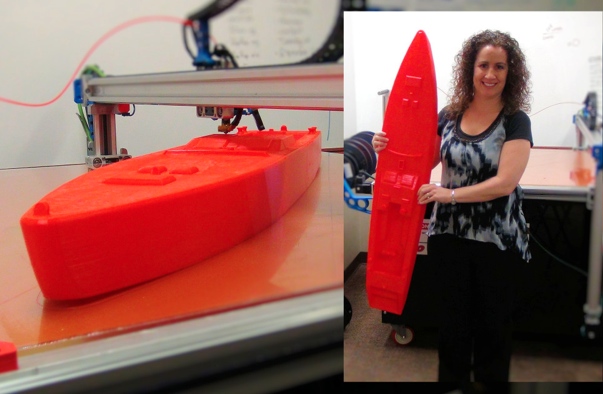
3DP Unlimited---a provocative corporate title for a large-format printer company---shows you what its new 3DP1000 can do ("1000" in the printer model-name stands for its 1,000 millimeter square build-plate)

3DP Unlimited—a provocative corporate title for a large-format printer company—shows you what its new 3DP1000 can do (“1000″ in the printer model-name stands for its 1,000 millimeter square build-plate)

Last week, I went looking for the next “step up” in 3D printers. I found the new 3DP1000—from 3DP Unlimited (formed only in January of this year but with 2 years of R, D & D run-up under the wing of its parent company PBC Linear)—operating on a tradeshow floor in New York City.

Here was a large-format printer with a hyper-capacious build-volume AND precision output—for a cost-effective price. The 3DP1000 is a recently released, industrial-grade, marketplace-entry 3D printer designed to leapfrog what—until now—has been prosumer-style, desktop 3DPs writ large.

Too large—really—to sustain the kind of 3D-printer quality output that industrial manufacturers have been demanding more and more from large-format machines. As the 3DP Unlimited tagline teases: “Why ‘Play Around’ with Ordinary 3D Printers?”

Having seen the 3DP1000 in action—and interviewed its creators—I’m now convinced that quality is the new black in 3DPs. AND, bigger quality bests smaller every time…

Germane to these comments and the breakneck evolution of 3DP products, ponder this. Have you ever wondered why—or, for skeptics, if!—the United States is still the premier industrial power in the world? I invite you walk the crowded aisles of an American, all-in-one, multi-sector, manufacturing-focused trade event—like the one running last week at the Javits Convention Center here in New York City.

  • First, outside the annual Hannover Fair in Germany, a “multi-show” of aligned or synergistic industrial segments isn’t found elsewhere. (Americans have always had a thing for crossing marketing, sales and gregarious behavior.)
  • Second, the business of America continues to be business—and, surprisingly, a significant percentage of that is beginning to look like “re-shoring” of the manufacturing we once “off-shored.” (Along with all those beautiful middle-class jobs…that 3DP will help restore here.)
  • Third—come the full maturation of the 3DP Revolution—many industrial and manufacturing support services are going to be disrupted out-of-business. (Don’t be in the packaging or logistics game when products are printed “locally.”) And,
  • Fourth, a few pioneers in 3DP—e.g., 3DP Unlimited—are already influencing design and manufacturing thought leaders via mega-trade shows like this one. (Where some benighted folks would not expect to find 3DP.)

This “multi-show”—taking up almost all of the Javits—doesn’t have a single title. (I’d call that a failure of branding by the producer/managers, UBM Canon Events…) It’s nonetheless touted as “The East Coast’s Most Comprehensive Event for Design, Manufacturing, Automation and Packaging.” (Doesn’t exactly trip off the tongue…) Here are the names of the six shows that are sub-components of this umbrella event: MedTechWorld/MD&D; Pack East; Atlantic Design & Manufacturing; Automation Technology Expo (ATX) East; PlasTec East and Pharmapack North America.

Of the upwards of 1,100 exhibitors, fewer than 10 were directly 3DP-related.

Joe Binka, Development Engineer (left) & Mark Huebner, Market Development Manager, of 3DP Unlimited of Rockford, IL, exchange on their company’s new large-format 3D printer, the 3DP1000.

Joe Binka, Development Engineer (left) & Mark Huebner, Market Development Manager, of 3DP Unlimited of Rockford, IL, exchange on their company’s new large-format 3D printer, the 3DP1000.

According to Mark Huebner, Market Development Manager of PBC Linear (the parent of 3DP Unlimited), we are “one of the newer companies in the space…and, yes, it’s the Wild West out there [in the 3D printing marketplace]. What sets it [the 3DP1000] apart is the build area. We’ve a meter by meter by ½ meter high usable print area.” The product’s model name—3DP1000—refers to the “1000 millimeter” X- and Y-axes.

Mark continued, “PBC Linear…makes industrial-strength linear actuators…long, straight screw-driven actuators… In their design process [for the 3DP1000], they [our engineers] looked at a number of desktop printers and couldn’t see how they could get the job done [for a large-format 3DP using that typical desktop technology]…We looked at all the desk top printers out there and decided to build our own…[our engineers] went at it with the industrial-strength stuff!”

Joseph Binka, Development Engineer for 3DP Unlimited, joined in with “We use all lead screw drive systems. Most 3D printers today are a combination of belt drives and lead screws. Working with PBC Linear [and their industrial savvy expertise], we were able to use 25 mm-pitch lead screws and use NEMA 23 [stepper] motors, allowing us to really put our 3D printer on steroids. Really beefed it up. So, now, we get really great accuracy and print resolution [down to a layer resolution of 70 microns] and also get good print speeds…”

Industrial-quality components and actuators—like all lead-screw drivers and integrated stepper motor/amplifiers—deliver higher precision and repeatability. This opens up new capabilities and functionalities that more than pay back the higher cost of this large-format 3D printer.

With a large build-plate AND precision, 3DP1000 users can take advantage of the flexibility presented by the meter-square—yet precise—build capability. Not just to create very large objects, but to pump-out multiple objects in one printing session.

So, what are some of the downsides? The basic printer is 300 pounds, the size is significantly larger than its meter-square build area and the print times for large objects can be in the tens of hours.

Mark Huebner continued with “How high can we go [with print resolution]? Here it’s a trade off [with speed]. We want to get as much plastic on the table as possi-ble. We’re working not only with .5 and .4 nozzles, we’re also working with 1 mm nozzles…we tailor that nozzle size to what clients want to do [and at what speed].”

“Everyone that I talk to seems to have a different end-use for the printer. Naval architecture, [regular] architecture, automotive, sculpture, special effects, props and set design in Hollywood. Art is one of the customer drivers… And, we’re also seeing a lot of engineering use. [Our printer] really expands the spectrum of use.”

Joe Binka (far right), Development Engineer of 3DP Unlimited, expounds on his company’s new large-format 3D printer, the 3DP1000, for booth guests at Automation Technology Expo (ATX) East, Javits Convention Center, 10 June 2014.

Joe Binka (far right), Development Engineer of 3DP Unlimited, expounds on his company’s new large-format 3D printer, the 3DP1000, for booth guests at Automation Technology Expo (ATX) East, Javits Convention Center, 10 June 2014.

Joe Binka picked up with “We’re seeing a lot of [engineering] customers who want to use the printer in [end-use] manufacturing.”

When quizzed on pricing, Joe stated that the “base platform…starts at $16,000. It really fits that niche. A lot of desktop printer [manufacturers] are trying to drive it down, drive it down, on price. Or, you go very high-end. There you see six-figure machines… Then, [with our price points], an engineer can print something real world.”

3DP Unlimited also tries to maintain affordable flexibility of the 3DP1000 printer by integrating open-source solutions with software and control platforms. According to Binka and Huebner—card-carrying members of the Maker Movement—open-source control solutions offer the customer more flexibility. And, will continue to be an integral part of the strategic positioning of the company going forward.

When I queried my hosts Huebner and Binka at the 3DP Unlimited booth about competition, Mark Huebner replied, “At this size [and price], we don’t see much competition.” (Hmm. How long might that last…?)

The next steps? Multiple heads: extruding and finishing. One-stop prototype machine as an evolving platform. Per Mark, “Customer buys this and wants to put a laser on it—or a CNC head—we want to help them to do that, helping us, too.”

And, one year from now? Mark Huebner: “Plug-and-play prototyping printer. Go on the Web site and order up your choice of solutions…”

When can I get one? “In production now. Typical lead times are four to six weeks.”

C’mon Back!

LAND

facebooktwittergoogle_plusredditpinterestlinkedinmail
Posted in Email, HOME, NY3DPWeek, Views | Leave a comment

3DP & Human Health (Part 4): Maker Care As The Stealth Base For The 3DP BioFacturing That Will Emerge From Nursing Units

DIY Maker-Care Players—At Every Level—Are Already 3DP-Producing “Exo-Solutions” To Meet Human Health Needs For Non-Invasive, Patient-Specific Prostheses, Devices & Systems: Next, The Front-Line Foot-Soldier Of DIY Health Practitioners—The Nurse!—Will Be 3DP-Empowered…

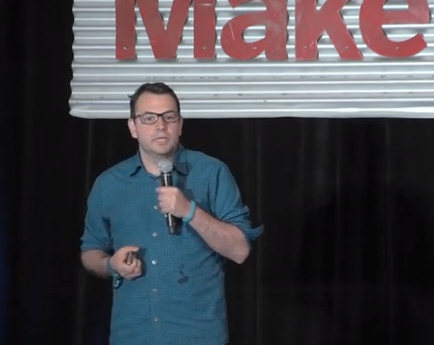
Jose Gomez-Marquez, Program Director for the "Innovations in International Health" initiative at MIT, also leads the Little Devices Lab at MIT, speaking at Maker Faire Bay Area on 23 May 2014 on the topic of "Makers in the Nursing Unit: Lessons Learned from America's Amazing MakerNurses."

Jose Gomez-Marquez, Program Director for the “Innovations in International Health” initiative at MIT, also leads the Little Devices Lab at MIT, speaking at Maker Faire Bay Area on 23 May 2014 on the topic of “Makers in the Nursing Unit: Lessons Learned from America’s Amazing MakerNurses.”

As we discussed in our last post—”Printing Exo-Solutions For Non-Invasive ‘HuBod Printed’ Healthcare…” of 2 June—DIY Maker Care innovators are devising entirely new healthcare solutions to meet a broad spectrum of human needs.

These Maker Care creators span the gamut from the uncredentialed, non-commercial in home-based and informal “Maker Spaces” to highly sophisticated, “edu-biz” collaborators combining 3DP proceeds from cutting-edge academic labs and “mechatronic” industrial floors. The 3DP innovations produced along this broadly defined, Maker-Care spectrum might start at one edge with 3DP’d, DIT (Do-It-Together), GET (Good-Enough Tech) and  muscle-mech-powered prosthetic hands (Robohand). At another 3DP’d extreme is highly sophisticated and engineered exo-skeleton Wearable Robots that respond to thought-commands by the paraplegic walker (Walk Again”)

Now, under the radar (isn’t this typically where the action is?), we find another locus where 3DP and Human Health are about to cross-pollinate. The Maker ethos is empowering DIY medi-mechatronic mash-ups to meet the missions of nurses and care-givers in healthcare institutions.

These stealth innovations begin—as we will see—with nurses devising “medico kludges” by cobbling them up in the supply closets of nursing units on the hospital floor.

Jose Gomez-Marquez, Program Director for the “Innovations in International Health” initiative at MIT, also leads the Little Devices Lab at MIT, spoke at Maker Faire Bay Area on 23 May 2014 on the topic of “Makers in the Nursing Unit: Lessons Learned from America’s Amazing MakerNurses.” Fascinating—as you can see in this YouTube video!

We’ve spoken before on this blog—and in this “3DP & Human Health” post series—about the democratization of technology, innovation and product-making delivered by 3DP. This democratization is typically an empowerment of people with visions of better ways to accomplish what needs to be done for the betterment of others.

Now, as Jose Gomez-Marquez says in his Maker Faire Bay Area presentation last month, “What we’re trying to do is to make affordable medical devices for everyone.”

Professor Gomez-Marquez has a unique perspective on worldwide efforts to provide low-cost and accessible tools of health. He studies the action and opines on it as Program Director for MIT’s “Innovations in International Health” initiative. 

Gomez-Marquez is finding medi-hackers everywhere. And—in the Human Health exigencies of life and death—extreme ingenuity comes from extreme need. To illustrate what people in extremis can accomplish, the Professor has even discovered a healthcare DIYer who managed to hand-fabricate a working—and effective—dialysis machine.

Even in the most invasive of procedures—repairing a beating heart—Gomez-Marquez points to the success of DIY ingenuity. He states that balloon angioplasty was a kitchen-table hack by a doctor with no R, D & D budget kludging up solutions in his kitchen.

Now, a desktop 3D Printer can sit on that kitchen table or in that nurses’ supply closet. What hacked healthcare innovations are likely to bubble up from the DIY/DIT (Do-It-Together) stew? Especially when nurse practitioners can apply their (literally!) hands-on expertise—and caregiver ethos—in Maker-style creativity 3DP-enabled?

Professor Gomez-Marquez is “hacking” the nurse’s world—and their medical-hardware innovation sensibilities—to learn from the culture that is known for bedside ingenuity. In 2013, he and his team “launched MakerNurse…to find inventive nurses around the country who combine the Maker ethic with their own mission to heal patients.”

Gomez-Marquez has already learned that “healthcare has lots of blackbox designs: biomed design is blackbox mentality.” So, opening the “blackbox,” hacking and reverse-engineering and innovating takes a special chutzpa-mindset among Maker Nurses.

So, the Professor opines that “Making in healthcare is less about technology and more about social, hierarchical and class issues.” He further states that “Nurse Makers are not prevalent in academic [based healthcare] centers: [Maker Nurses there] see the track of innovation as very advanced” and thus less susceptible to their DIY hacking. Not surprisingly, the Nurse Maker action is more readily found “mostly in small to medium-sized healthcare institutions.”

Or—asked another way—does authority, gate-keeping and credentialism stifle innovation? Hmm. Nurses: perhaps your traditional “stealth mode” of making (better) things happen for your patients—and hiding the 3D Printer in your supply closet—is still best??

C’mon Back!

LAND

facebooktwittergoogle_plusredditpinterestlinkedinmail
Posted in Email, HOME, NY3DPWeek, Views | Leave a comment